
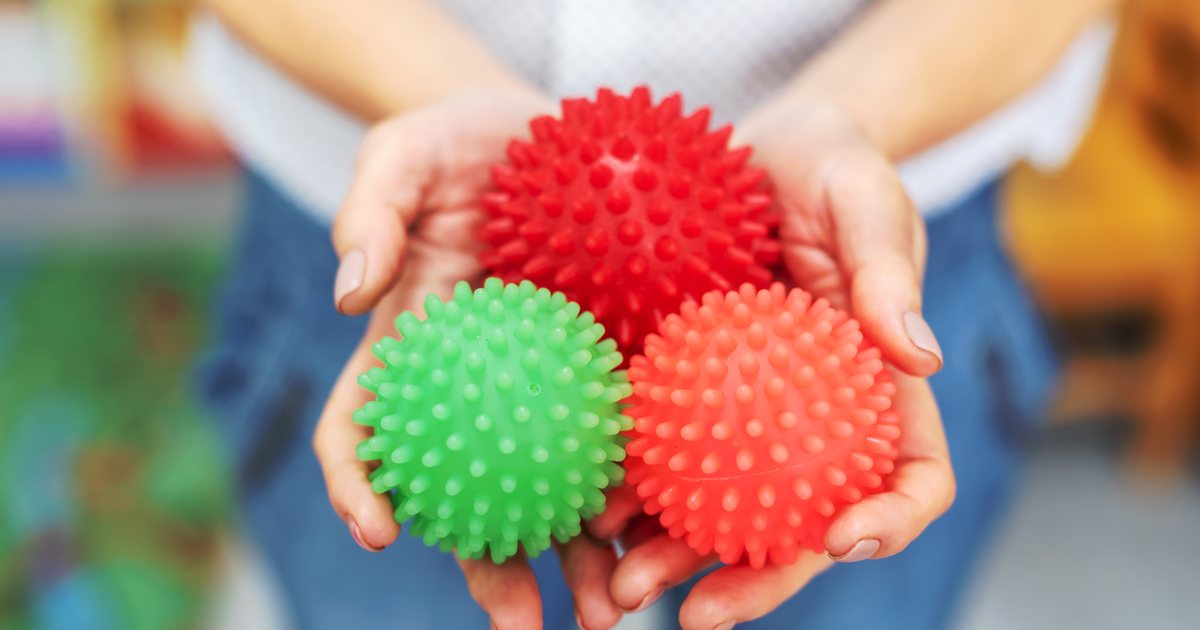
Sensory toys are sold with confidence and bought with hope. The market runs from a two-dollar squeeze ball to a four-hundred-dollar swing, and most of it is described as if it were treatment. Very little of it has been tested that way, and the few products that have been tested did not do what the box says.1,2
That is not a reason to buy nothing. It is a reason to buy differently: match the tool to what your child is actually looking for, spend less than you were about to, and judge the result yourself over a couple of weeks. This guide is organized around that. It covers what the evidence supports, what to look for in each category, what to avoid, and one pick per category.
If you want the clinical case in full, the DrSensory side of this site has it: what the evidence actually says about sensory toys and tools. This page is the shopping half. If your child is under two, the developmental toys for baby's first year guide is the better starting point.
Prices checked September 15, 2026 against each manufacturer's own product page and may have changed since.
Key takeaways
- Buy the thing your child likes, at the price of a thing your child likes. The problem is not preference, it is spending limited money and hope on a product sold as a fix.
- A 2015 review of 30 studies covering 856 children concluded insufficient evidence exists to support sensory tools. That means the research is weak, not that the tools are useless.
- The direct weighted-blanket trial, 73 autistic children with severe sleep problems against an identical-looking light blanket, found no difference in sleep length, time to fall asleep, or waking. Children and parents preferred the weighted one anyway.
- Fidgets do not have the evidence their marketing implies. The one controlled trial of fidget spinners, in 60 young children with ADHD, found attention was worse while the spinner was in use.
- Try the cheapest version first. A lump of putty tells you whether tactile input helps before a forty-dollar kit does.
- Check the CPSC recall database before buying any weighted or wearable product. Weighted products for children have been recalled twice for the same fatal hazard.
- Nothing on a cord around the neck during sleep, naps, or unsupervised time. A breakaway clasp reduces the risk; it does not remove it.
- Avoid beaded chew designs, which can shed pieces, and any necklace without a breakaway clasp.
Do sensory toys actually work?
Some do something. Most have not been tested, and the ones that have are humbling.
Deep pressure is the exception. A 2025 systematic review of 21 controlled studies found strong evidence for deep pressure tactile input, and strong evidence for training caregivers to use sensory strategies.1 That is the best news in this field, and it is worth reading twice: the two things with the strongest support are a kind of touch that needs no equipment, and a parent who understands the child's profile. The same review found moderate evidence that alternative seating — wobble cushions, therapy balls — did not improve attention, and too few studies on changing the environment to rate it either way.1
Fidgets do not have the evidence their marketing implies. A review of classroom fidget research concluded there is not sufficient support for using them as a universal aid.3 The one controlled trial of fidget spinners, in 60 young children with ADHD, found attention was worse while the spinner was in use — even inside an otherwise effective classroom program.4
Weighted blankets are liked but not proven. The direct trial — 73 autistic children with severe sleep problems, a real weighted blanket against an identical-looking light one — found no difference in how long they slept, how fast they fell asleep, or how often they woke.2 Children and parents preferred the weighted one anyway, and it was well tolerated.2 Weighted vests have been reviewed more than once and the evidence does not support them.5,6
Across the category, a 2015 review of 30 studies covering 856 children — therapy balls, swings, chewy tubes, weighted vests — concluded that insufficient evidence exists to support their use. Note what that does and does not say: the review found the research limited by weak designs and high risk of bias, not that the tools were proven useless.7
None of this means a child's preference is wrong. A child who reaches for the lap pad is telling you something true. The problem is spending limited money and hope on a product sold as a fix. Buy the thing your child likes, at the price of a thing your child likes.
How do I choose a sensory toy for my child?
Match to profile, not to age or diagnosis. Two children with the same diagnosis can need opposite things from the same shelf.
If your child seeks input
- Crashes into furniture, chews collars, cannot sit still, loves being squeezed.
- Start with the chew, weighted and movement sections.
- See sensory seeking and under-responsivity.
If your child avoids input
- Covers ears, hates tags and seams, melts down in busy rooms, gags at textures.
- Start with the noise and light section — the best tool may be removing something, not adding it.
- See sensory over-responsivity.
Most children are a mix, and the mix changes with tiredness, hunger, and the day. If you are not sure which pattern fits, types of sensory processing differences walks through it, and an occupational therapist can usually tell you in a session or two — and will usually suggest things you already own before things you have to buy.
Specialist retailers that stock sensory toys for children tend to group products by input type — oral, tactile, proprioceptive, vestibular, auditory — which is a more useful way to browse than by age or condition. That is how the rest of this guide is organized.
Three rules before you buy anything:
- One thing at a time. Introduce a single tool, decide in advance what you expect to see, and give it two weeks. If you cannot say what changed, it did not.
- Cheapest version first. A lump of putty tells you whether tactile input helps before a forty-dollar kit does.
- Check the recall list. Weighted products for children have been recalled twice for the same fatal hazard.8,9 Search the CPSC recall database for any weighted or wearable product before it goes in the cart.
Best chew toys and oral sensory tools
Who it is for: children who chew on collars, sleeves, pencils, or their own hands — usually seekers, sometimes children managing anxiety through the jaw.
What the evidence says: chewing tools were included in the 2015 review that concluded there is insufficient evidence to support sensory-based treatments.7 There is no trial showing a chew tool improves attention or behavior. What a chew tool reliably does is redirect chewing away from things that should not be chewed. That is a practical benefit, and it is the honest claim.
What to look for:
- Food-grade silicone, seamless, with no paint or coating.
- Firmness matched to the child: light chewers need soft, heavy chewers need a firm tool or it shreds in a week.
- A form the child will actually use in public — a pencil topper or a hand-held tool goes further than a necklace with an older child.
- Replaceable. Any chew tool that starts to tear gets replaced, not watched.
What to avoid:
- Anything on a cord around the neck during sleep, naps, or unsupervised time. The AAP recommends no jewelry on infants at all, citing FDA reports of choking on beads and a strangulation death during a nap.10 That warning is about infant teething jewelry, not sensory chews for older children — but the hazard is a cord around a neck, and the label on the box does not change it.
- Beaded designs, which can shed pieces.
- Necklaces without a breakaway clasp, if a necklace is what you are buying.
1. Best chew tool: ARK's Krypto-Bite Chewable Gem Necklace
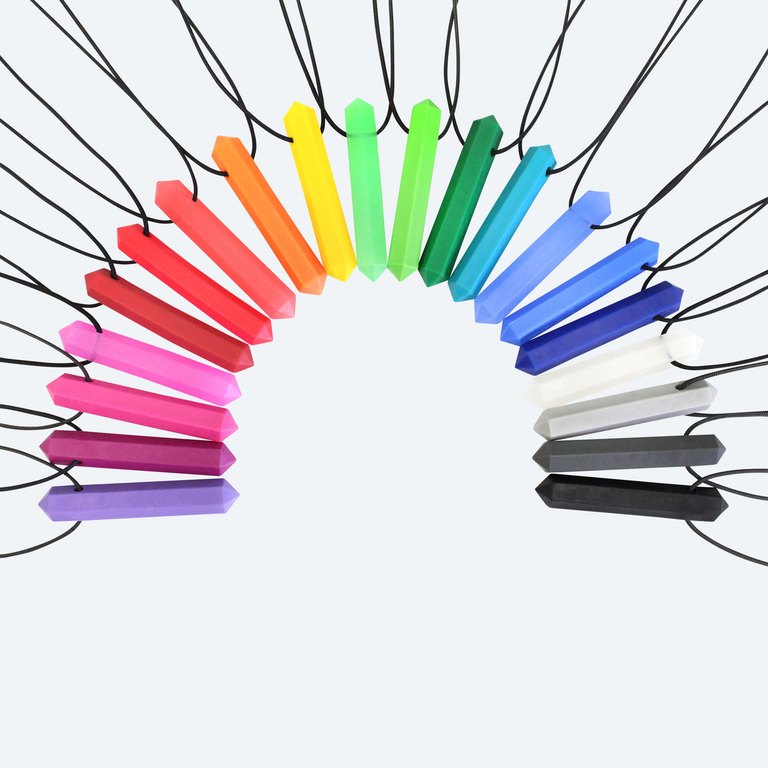
ARK sells this pendant in three color-coded firmness levels — Standard for light chewers, XT for moderate, XXT for the child who destroys everything else — and that single fact is why it is the pick. Firmness is the variable that decides whether a chew tool lasts a month or a week, and almost nothing else on the market lets you choose it. The pendant is molded medical-grade elastomer, it is 3 inches long so it reaches the back molars, and it is made in Columbia, South Carolina. It arrives as one pendant plus one 30-inch cord with a safety breakaway clasp, and the pendant does its job without the cord: a child who will not wear a necklace can hold the pendant, keep it in a pocket, or clip it to a bag, which is usually the better answer past about age eight.12
Pros
- Three firmness levels: the only spec that reliably predicts how long a chew tool survives, and you pick it at checkout.
- Reaches the back molars: a 3-inch pendant gets to where heavy chewers actually want pressure.
- Seamless and uncoated: molded medical-grade elastomer, no paint to wear off, dishwasher-safe on the top rack.
- The cord is optional: pendant and cord ship as separate pieces, so it works as a hand-held tool with no cord at all.
Cons
- If you use the cord, it comes off for sleep. A breakaway clasp reduces the risk but does not remove it, and nothing on a cord stays on for naps or bedtime.
- More than a generic silicone chew, and a child who is gentle on tools will get the same result from something cheaper.
Best fidget toys and tactile tools
Who it is for: children who need something in their hands to stay in a chair; children who process by touching. Read the evidence section first — this is the category with the weakest case.
What the evidence says: not sufficient support for classroom use,3 and a controlled trial in which fidget spinners made attention worse.4 If a fidget is going to school, the test is whether the teacher notices less disruption, not whether your child likes it.
What to look for:
- Silent. Clicking, spinning, and light-up fidgets are toys, not tools, and they pull attention rather than absorb it.
- Small enough to use under a desk without looking.
- No small parts for children who mouth objects — the federal toy standard sets the small-parts test, and anything marketed for under-three has to pass it.11
- Putty or a stress ball rather than a spinner. Sustained resistance is closer to the deep-pressure input that does have evidence.1
What to avoid:
- Fidget spinners. The one trial that tested them found attention got worse.4
- Anything with magnets a child could swallow.
- Fidget “kits” of twenty items — one tool a child returns to beats twenty they rotate through.
If putty is the tactile tool that fits, the clinical side has a full page on it: thinking putty for sensory input.
2. Best fidget: Crazy Aaron's Thinking Putty — Liquid Glass
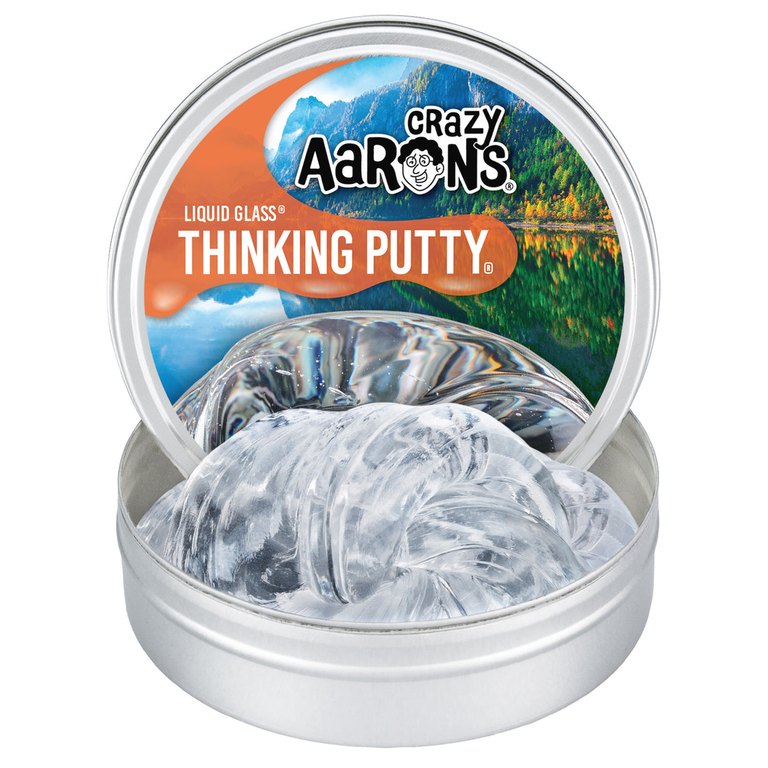
Read the evidence section before you buy anything in this category. Given that, putty is the fidget worth the money: it is silent, it needs no batteries, it cannot roll off a desk and it gives sustained resistance rather than a spin, which is the closest a hand-held fidget gets to the deep pressure input that actually has support behind it.1 The tin holds 1/5 lb (3.2 oz) of non-toxic silicone putty, it does not dry out, and it leaves nothing on the hands. We picked the clear Liquid Glass because it is the plainest thing they make — no magnets, no glow, no scent, nothing that turns a tool back into a toy.13
Pros
- Silent: no clicking or spinning, which is the difference between a tool a teacher tolerates and one they confiscate.
- Sustained resistance rather than a spin — the input closest to the one category with strong evidence.
- Does not dry out and leaves no residue, so the tin survives being forgotten in a bag.
- Cheap enough to test with: $15 answers whether tactile input helps at all before you spend more.
Cons
- Choking hazard, contains small parts; ages 3+. Not for a child who still mouths objects.
- It picks up carpet lint and hair, and it will stick to fabric if it is left out of the tin.
Best weighted and deep pressure products
Who it is for: children who love tight hugs, burrow under couch cushions, ask to be squeezed, and settle when held firmly — typically seekers and some children with anxiety.
What the evidence says: deep pressure tactile input has strong evidence,1 which is the best evidence on this page. The product usually sold to deliver it does not: weighted blankets did not improve any sleep measure in a randomized trial, though children preferred them.2 Weighted vests are not supported.5,6 The gap between the input and the product matters, because deep pressure needs no product at all — firm hugs, being rolled in a blanket while awake and watched, lying under sofa cushions. Buy the product for the preference, not the effect.
What to look for:
- A lap pad before a blanket. Cheaper, portable, used while awake and supervised, and it tells you whether your child wants the input at all.
- No zippered or removable cover a child can climb inside. This design detail is what killed two children in 2022.8
- Weight the child can remove alone, every time, without help.
- Evenly distributed filling (glass beads sewn in a grid, not loose pellets).
What to avoid:
- Any weighted product for a child under two, and never in a crib or for sleep in infancy. The DrParenting page on weighted blankets for infants covers why.
- Weighted vests for behavior or attention. Reviewed repeatedly; not supported.5,6
- Weighted blankets sold as a sleep treatment. Buy one if your child likes it; do not buy a heavier one when the first does not fix sleep.
- Any weighted product for a child who cannot reposition themselves or call out.
3. Best weighted product: Harkla Weighted Lap Pad (5 lbs)
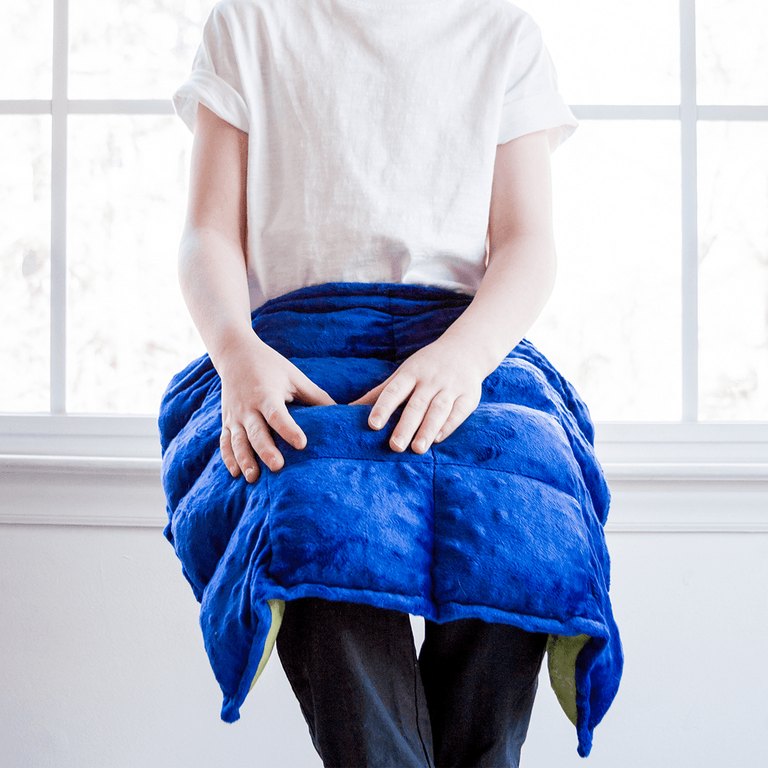
This is the pick because of a construction detail rather than a feature: the cover is not separately removable. The whole pad goes in the wash as one piece. That is the exact design property missing from the blankets the CPSC recalled, where a child unzipped a cover and climbed inside.8 It is 21 by 19 inches with 5 lb of glass beads held in a non-woven inner bag, so the weight stays spread instead of pooling, and it is used across the lap while the child is awake and sitting rather than over the body during sleep. Harkla rates it for ages 3 and up and says explicitly not to use it with children under 2. Buy it because your child likes the pressure; the trial evidence does not say it will fix sleep.2,14
Pros
- No removable cover to climb inside — the single design property that separates it from the recalled products.
- Glass beads in a sewn inner bag, so weight stays evenly distributed rather than sliding to one end.
- Lap-sized, used awake: cheaper than a blanket and it tells you whether your child wants the input at all.
- Machine washable as one piece, with a lifetime warranty from the manufacturer.
Cons
- Ages 3+ and never under 2, and never for a child who cannot lift it off without help.
- 5 lb is a lot for a small three-year-old. If your child cannot move it alone, this is the wrong product, not the wrong weight setting — there is only one weight.
Best movement and seating tools
Who it is for: children who spin, rock, hang upside down, and cannot sit through a meal — vestibular seekers.
What the evidence says: alternative seating — wobble cushions, therapy balls — has moderate evidence that it does not improve attention.1 Swings and therapy balls were among the treatments in that same 2015 review, which found insufficient evidence to support them.7 A movement break — running, jumping, climbing — is free and gives more input than any cushion. If your child needs to move, the tool is the playground.
What to look for:
- For a swing: a mounting kit rated for the load, into a joist or a stand, installed by someone who has done it before. Most swing injuries are hardware failures.
- For a cushion: only if a teacher or therapist has asked for one, and treat it as a trial.
- Anything that lets the child get more movement, not less — a mini trampoline beats a seat cushion for a seeker.
What to avoid:
- Swings hung from a doorway bar or a ceiling hook without a joist.
- Buying a wobble cushion expecting better attention. The evidence says it will not.1
- Movement equipment for a child who is over-responsive to movement — it can escalate rather than settle.
4. Best movement tool: Skywalker 36" Round Hopper Mini Trampoline
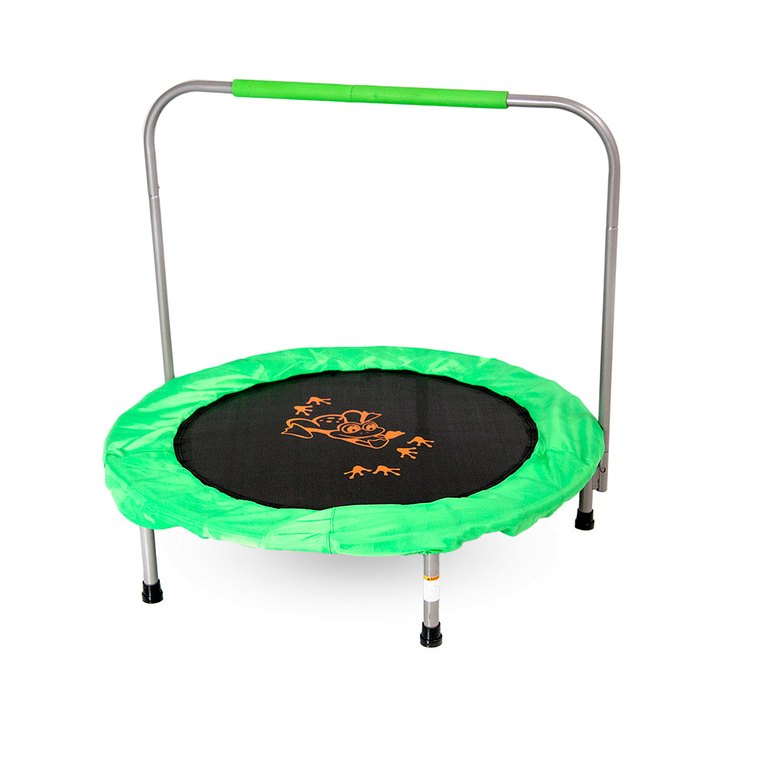
A child who needs to move needs to move, and a mini trampoline gives more input in five minutes than a seat cushion gives in a school day — which matters, because the evidence on alternative seating says it does not improve attention.1 This one uses 26 stretch bands instead of steel springs, has a padded frame cover and a padded handlebar for balance, and Skywalker states it meets ASTM standards. Read the weight limit before you buy: the maximum recommended user weight is 60 lb, which in practice means it is outgrown somewhere around age seven or eight. For an older or heavier child this is the wrong product and you want a full-size rebounder rated for their weight.15
Pros
- Stretch bands, not steel springs: a softer bounce and no exposed spring gaps.
- Padded handlebar for children who need something to hold while they find their balance.
- Padded frame cover over the edge, and the manufacturer states it meets ASTM standards.
- Indoor-sized at 3 ft across and 2.7 ft tall, so it fits a bedroom or a corner of a living room.
Cons
- 60 lb maximum user weight — check your child's weight before ordering, not after.
- Only one child at a time, and it still needs a clear space and an adult in the room.
Best tools for noise and light sensitivity
Who it is for: children who cover their ears at hand dryers, flinch at fluorescent light, melt down in stores — over-responsive children. This is the one category where the tool removes input rather than adding it, and that is also the category with the most obvious logic behind it.
What the evidence says: the 2025 review found too few studies to rate environmental modification either way,1 and an earlier review rated it moderate in clinical settings.6 That is thin, but the mechanism is not in doubt — less noise reaching the ear is less noise — and the risk is close to zero. The caution is different here: a child who never hears a hand dryer never gets used to one. Headphones are for surviving the store, not for every room.
What to look for:
- Passive ear defenders (over-ear, no electronics) for young children. A noise-reduction rating in the low-to-mid 20s dB is enough; more is not better.
- Comfortable enough to wear for twenty minutes without complaint, which usually means a padded band and cups that do not clamp.
- For older children, low-profile earplugs designed to reduce rather than block, so speech is still audible.
- A cap with a brim, or sunglasses, for light — cheaper than any specialist product.
What to avoid:
- Noise-canceling electronics for young children, which are expensive, fragile, and unnecessary for the problem.
- Headphones as a default rather than a rescue. Use them for the known-bad situations and take them off when the situation ends.
- Tinted lenses marketed for specific conditions. A hat works.
5. Best for noise sensitivity: Alpine Muffy Kids
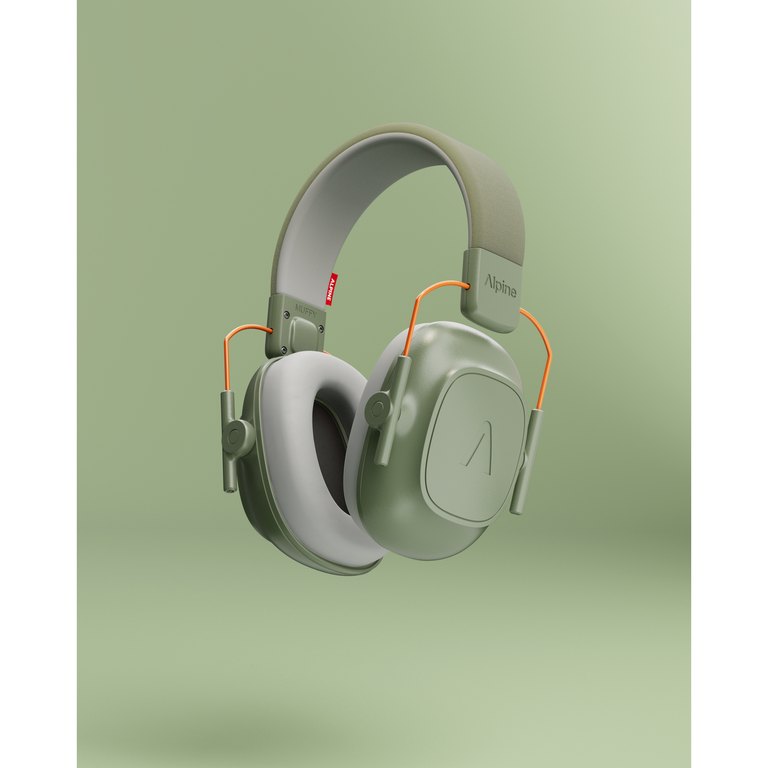
Passive, over-ear, no electronics and no battery: this is the whole category done simply. Alpine gives 25 dB of damping and states the earmuffs are CE certified and ANSI tested, with an adjustable soft-lined headband and a storage bag. That figure is an SNR rating, the European measure — US products are usually labeled NRR, and the two numbers are not directly comparable, so do not read 25 dB SNR as equal to a 25 dB NRR. It is in the range that matters here, which is enough to take the edge off a hand dryer or a supermarket without sealing your child off from speech. Alpine rates these for ages 5 to 16; for a younger child their Muffy Baby is the one built for the smaller head.16
Pros
- Passive, no electronics: nothing to charge, nothing to break, and it works the moment it goes on.
- 25 dB damping (SNR), which takes the peak off without cutting your child out of conversation.
- CE certified and ANSI tested, per the manufacturer.
- Adjustable soft-lined band and a bag, so it survives being carried everywhere it is actually needed.
Cons
- Ages 5 to 16. Under five, the fit is wrong and you want Muffy Baby instead.
- It is a rescue tool, not a default. Worn in every room, it removes the ordinary exposure a child needs.
Which sensory toys are unsafe?
Most of what is on this page carries no real risk. Three things do.
Weighted products a child can get inside. In December 2022 the CPSC recalled about 204,000 children's weighted blankets after a 4-year-old and a 6-year-old became entrapped inside the removable cover and died of asphyxia; four entrapment reports were received in total.8 A second brand was recalled for the same hazard in October 2023.9 In both cases a child unzipped the cover and climbed in. No cover a child can enter; nothing weighted for a child who cannot get out alone.
Cords around the neck. Chew necklaces, lanyard fidgets, anything worn. The AAP's warning is about infant teething jewelry,10 and it would be wrong to say it applies to a six-year-old with a breakaway chew necklace at school. But nothing on a cord stays on during sleep, and nothing beaded goes near a child who mouths objects.
Small parts and magnets. The federal toy standard defines what counts as a small part and what has to be tested for children under three.11 Sensory kits sold online are often assembled from parts that were never tested as a set. If your child mouths objects, buy items marketed for under-three, which have to pass the small-parts test, regardless of your child's actual age. Magnetic desk toys — the small ball sets — are not for any child who might swallow one.
How do I know if a sensory toy is working?
Decide what “working” means before it arrives. Pick one thing you can see — fewer collar bites, a whole dinner in the chair, a car ride without a meltdown — and count it for a week before and two weeks after. If the number moved, keep the tool. If it did not, the tool did not work, however much the child likes it. Liking it is a fine reason to keep a cheap thing; it is not a reason to buy the next one up.
Two patterns mean stop and rethink. If the tool becomes the only way the child can settle, you have built a dependency rather than a skill, and the plan needs a therapist. And if the tool escalates — the swing that winds a child up instead of down, the fidget that becomes the thing they fight about — that is the profile telling you it needs the opposite input.
Sensory tool checklist by profile
For a seeker (crashes, chews, cannot sit): a chew tool · putty or a stress ball · a lap pad · a trampoline or a climbing frame · a movement break before any seated task.
For an avoider (covers ears, hates textures, overwhelmed in crowds): ear defenders for known-bad places · a hat · tagless clothing · a quiet corner with a door · advance warning before transitions. Most of this is not a toy.
For a mixed profile (most children): start with the cheapest item from each list, one at a time, and let the child's choices tell you which list they are really on.
For any child: the parent who understands the profile has stronger evidence behind them than any product on this page.1 Sensory diet strategies is where to start building that.
Frequently asked questions
Do sensory toys help with ADHD?
Not in the way they are sold. Fidget toys do not have enough evidence for classroom use, and the one controlled trial of fidget spinners in children with ADHD found attention got worse while the spinner was in use. What does have strong evidence is deep pressure input and a parent who understands the child's sensory profile. Buy a tool your child likes, cheaply, and judge it yourself.
What is the best sensory toy for a child with autism?
There is not one, because autistic children have opposite sensory profiles as often as similar ones. A child who seeks input needs chew, weight, and movement; a child who avoids it needs ear defenders and a quiet corner. Match the tool to what your child does, not to the diagnosis.
Are weighted blankets good for kids?
Children tend to like them, and that is a fair reason to buy one. A randomized trial in autistic children found they did not improve sleep by any measure. Never use one on a child under two, never with a cover a child can climb inside — that design has killed two children — and never for a child who cannot remove it alone.
Are chewable necklaces safe?
For an older child, awake and supervised, with a breakaway clasp, generally yes. Never during sleep or naps, never beaded, and never on an infant — the AAP recommends no jewelry on infants at all.
Do fidget spinners help kids focus?
The one controlled trial says the opposite: attention was worse with the spinner in use. Silent putty or a stress ball is a better bet if your child needs something in their hands.
What sensory toys are good for a sensory seeker?
A chew tool, putty, a lap pad, and something to jump on or climb. Movement breaks before seated tasks help more than any cushion.
How do I compare calming toys against stimulating ones for a child with autism?
By what your child does, not by the label. A child who seeks input — crashes, chews, cannot sit still — usually settles with more input (a chew tool, weight, movement), so a “stimulating” toy is the calming one for them. A child who avoids input settles with less, so the calming tool is ear defenders or a quiet corner, not a toy at all. Try the cheapest item from the matching list first and watch for two weeks.
What sensory tools help a child who is overwhelmed by noise?
Passive over-ear defenders with a noise-reduction rating in the low-to-mid 20s dB, worn for the known-bad situations and removed afterward. For older children, reducing earplugs that leave speech audible. A brimmed hat handles most light sensitivity.
How do I know if a sensory toy is working?
Pick one visible thing, count it for a week before and two weeks after. If the number moved, keep it. If the tool becomes the only way your child can settle, or it escalates rather than calms, talk to an occupational therapist.
From the clinical side: The evidence behind every claim on this page, in full, is on DrSensory: what the evidence actually says about sensory toys and tools.
Need more than an article?
A product can only do so much. If something about how your child eats, moves, plays, or copes with noise has been on your mind, a pediatric therapist is the person who assesses it — and most families do not need a referral to ask.
Find a therapist near you →Related DrParenting guides
All DrParenting guides →More from DrSensory
DrParenting covers the gear. DrSensory covers the development behind it, written and reviewed by clinicians.
Sources
- Piller A, McHugh Conlin J, Glennon TJ, Andelin L, Auld-Wright K, Teng K, Tarver T. Systematic review of sensory-based interventions for children and youth (2015–2024). Frontiers in Pediatrics. 2025;13:1720179. Twenty-one level I and II studies, May 2015–January 2024, PRISMA-guided. Strong evidence for deep pressure tactile input and for caregiver training in sensory strategies; moderate evidence that alternative seating did not improve attention; lack of evidence on sensory environmental modifications. doi:10.3389/fped.2025.1720179 · PMID 41321460
- Gringras P, Green D, Wright B, Rush C, Sparrowhawk M, Pratt K, et al. Weighted Blankets and Sleep in Autistic Children — A Randomized Controlled Trial. Pediatrics. 2014;134(2):298–306. Placebo-controlled crossover in 73 children aged 5–16 with ASD and severe sleep problems, measured by actigraphy; no difference in total sleep time, sleep onset, or night waking; preferred by children and parents, and well tolerated. doi:10.1542/peds.2013-4285
- Kriescher SL, Hulac DM, Ryan AM, King BL. Evaluating the Evidence for Fidget Toys in the Classroom. Intervention in School and Clinic. 2023;59(1):66–69. Concludes there is not sufficient support for implementing fidget toys in the classroom. doi:10.1177/10534512221130070
- Graziano PA, Garcia AM, Landis TD. To Fidget or Not to Fidget, That Is the Question: A Systematic Classroom Evaluation of Fidget Spinners Among Young Children With ADHD. Journal of Attention Disorders. 2020;24(1):163–171. A-B-A-B design, 60 children, mean age 4.86; spinner use associated with poorer attention across phases, within an evidence-based classroom intervention. doi:10.1177/1087054718770009
- Stephenson J, Carter M. The use of weighted vests with children with autism spectrum disorders and other disabilities. Journal of Autism and Developmental Disorders. 2009;39(1):105–114. Evidence does not support use. doi:10.1007/s10803-008-0605-3
- Bodison SC, Parham LD. Specific Sensory Techniques and Sensory Environmental Modifications for Children and Youth With Sensory Integration Difficulties: A Systematic Review. American Journal of Occupational Therapy. 2018;72(1):42–53. Moderate evidence for sensory modifications to a clinical setting; limited evidence for weighted vests. doi:10.5014/ajot.2018.029413
- Barton EE, Reichow B, Schnitz A, Smith IC, Sherlock D. A systematic review of sensory-based treatments for children with disabilities. Research in Developmental Disabilities. 2015;37:64–80. Thirty studies, 856 children; interventions included therapy balls, swings, chewy tubes and weighted vests; the review concludes that “insufficient evidence exists to support their use”, with the literature limited by insubstantial treatment outcomes, weak experimental designs, or high risk of bias. PMID 25460221. doi:10.1016/j.ridd.2014.11.006
- U.S. Consumer Product Safety Commission. Recall 23078, December 22, 2022. About 204,000 Target Pillowfort children's weighted blankets; a 4-year-old and a 6-year-old became entrapped in the removable cover and died of asphyxia; four entrapment reports in total. cpsc.gov. Checked September 2, 2026.
- U.S. Consumer Product Safety Commission. Recall 24702, October 12, 2023. A second children's weighted blanket recalled for the same entrapment and asphyxiation hazard. cpsc.gov. Checked September 2, 2026.
- American Academy of Pediatrics. Teething Necklaces and Beads: A Caution for Parents. The AAP does not recommend that infants wear any jewelry, citing FDA reports of choking on broken beads and the strangulation death of an 18-month-old during a nap. healthychildren.org. Checked September 2, 2026.
- Office of the Federal Register. 16 CFR Part 1250 — Safety Standard for Toys. ecfr.gov. Checked September 2, 2026.
- ARK Therapeutic. ARK's Krypto-Bite Chewable Gem Pendant Necklace. arktherapeutic.com. Price, the three firmness levels, medical-grade elastomer, 3-inch pendant, 30-inch breakaway cord and the ages 3+ small-parts warning are the manufacturer's own. Checked September 2, 2026.
- Crazy Aaron's. Liquid Glass Thinking Putty. crazyaarons.com. Price, the 1/5 lb (3.2 oz) tin size, non-toxic silicone, ages 3+ and the choking-hazard warning are the manufacturer's own. Checked September 2, 2026.
- Harkla. Weighted Lap Pad (5 lbs). harkla.co. Price, the 21×19-inch size, glass-bead fill in a non-woven inner bag, the non-removable cover and the ages 3+ / not-under-2 guidance are the manufacturer's own. Checked September 2, 2026.
- Skywalker Trampolines. 36" Round Hopper Mini Trampoline. skywalkertrampolines.com. Price, the 60 lb maximum recommended user weight, 26 stretch bands, padded handlebar and frame cover, and the ASTM statement are the manufacturer's own. Checked September 2, 2026.
- Alpine Hearing Protection. Muffy Kids. alpinehearingprotection.com. Price, the 25 dB SNR figure, the ages 5–16 range and the CE-certified / ANSI-tested statement are the manufacturer's own. Checked September 2, 2026.
Medical disclaimer. This page is for general educational purposes and does not constitute medical advice, diagnosis, or treatment. Product information is checked against the manufacturer at the date shown and can change without notice — confirm weight and age limits on the product itself before you rely on them. Talk to your pediatrician about your own child.